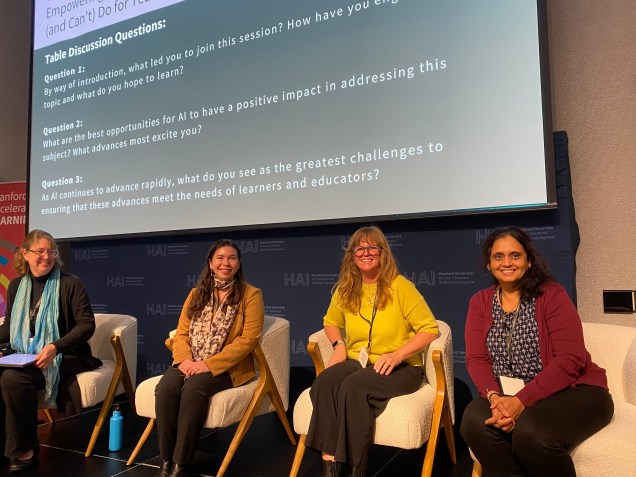
It’s been a little over a month since I had the opportunity to present on the panel, “What AI Can (and Can’t) Do for Teachers” at the Stanford AI + Education Summit, and I finally have time to reflect on the key takeaways I had from the conference (mostly because I’ve been trying to catch up on grading— clearly, I have not yet outsourced that task to AI).
It felt really exciting and hopeful during an otherwise uncertain and distressing time for this country to hear educators, academics, and non-profit and business leaders discuss their hopes for how AI could create a more positive future for students, while acknowledging the realities that AI literacy is essential and that not everyone will benefit equally from the use of AI in education.
Still, I am skeptical of some of the claims I heard about how AI will transform education for the better, both at the conference and from articles I’ve read online. Based on my experience as a high school English teacher who has taught AI literacy and experimented with AI in my classroom, here is what I think AI can and can’t do for teachers:
- AI cannot create more time for teachers to “teach.” One claim I heard repeated both at the conference and online is that AI will free up teachers from busy work and allow us to do more of the heart of what we love to do: teach students. This sounds great at first, but teachers in the US actually spend more time directly in contact with students than teachers in most other countries, leaving little time in the workday for lesson planning and grading. If teachers use AI tools to make the use of their limited unstructured work time more efficient, that would definitely improve our work-life balance, but it wouldn’t necessarily create more time for us to teach students since that’s what we spend most of our contracted work day doing already. I’m concerned that if school districts promote AI as an efficiency tool, they will use the improved productivity from teachers to justify giving us more students per class and even less preparation time during the school day.
- AI will not necessarily improve student engagement if we use AI to give students personalized instruction on screens. When I discuss how to make education more engaging with my students, I never hear any of them say that they want a computer program to guide them through tasks that they already don’t enjoy doing. Most frequently they mention wanting to do more hands-on learning, solve real world problems, and play fun educational games with their classmates. AI can help teachers plan more engaging lessons for sure, and it’s already really useful for helping teachers gamify content through apps like Kahoot, Pear Deck, and Quizziz which already have AI features. But I don’t think most students will view one-on-one interaction with a chatbot as a reason to come to school.
- AI can’t do the grading for us. AI is useful for assessments for sure, and it can help us automate some of our grading. But as an English teacher, I’m always going to read what students write (not necessarily everything , but some of it). That is how I get to know my students, learn their stories, and understand their strengths and weaknesses. Using an AI tool to summarize how they performed on an essay task without actually reading their work feels dishonest. I don’t mind using AI to supplement the task of giving feedback, however.
That brings me to what I think AI can actually help us do:
- AI can help us make learning more accessible. I think there is a lot of potential for AI to help us differentiate our lesson materials and instruction to support students with different skill levels, interests, and needs. It can help us brainstorm new ways to engage students and support them with just-in-time instruction, and it can analyze student data to inform instruction. For example, I’ve used the Brisk chrome extension to analyze trends in my students’ writing based on the rubric I’m using to asess their work.
- AI can act as a thought partner for improving our instruction. I think AI will be a really useful metacognitive tool for both students and teachers who will be able to track their progress using AI tools and periodically reflect on their learning. I was excited to see this program developed by researchers at UC Irvine which is experimenting with using AI to help students track their skills and their growth through an ongoing portfolio.
- AI can be another voice of feedback for our students. Our students can ask AI chatbots for help when their teachers aren’t available. Students are asking AI to explain complex topics to them in digestible bites, for example. In my English and ELD classes, I use Brisk to provide feedback to my students on their writing before I review it myself so they at least have a baseline for revising their work. Still, if we want to empower students to use AI in a way that supports their learning, we must teach students AI literacy, so they learn how to use AI chatbots as a tool, not as a crutch. We must also teach them to be skeptical of AI’s output. Though hallucinations have decreased, the implicit bias embedded in AI models against marginalized groups still exists, so we need them to think critically about the responses from generative AI and consider how to use these tools ethically.
When considering whether AI will have a positive impact on education, I am a pragmatic optimist. There are so many ways it can be abused, of course, but I do think if we use it thoughtfully it can be a tool for learning that empowers both teachers and students. To do that, we need to use it in ways that are already proven to boost student learning and engagement rather than promote it as a miracle cure for all that ails us in the education system.
 Molly Montgomery