Reflections on the Promise of AI for Teachers

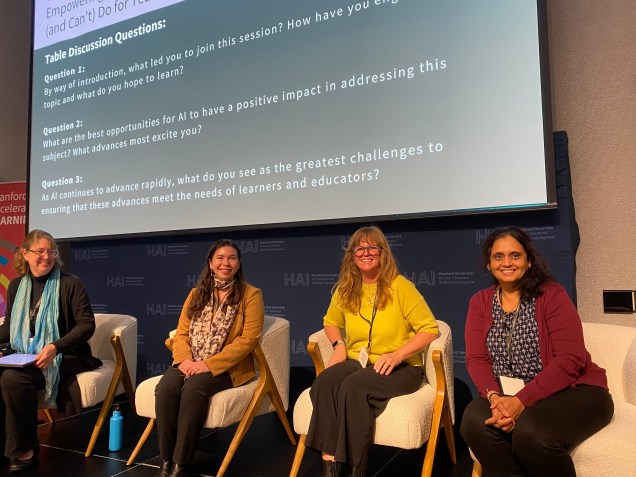
Panel members on the What AI Can And Can't Do for Teachers panel
Photo Credit: Stephanie Sumarna

It’s been a little over a month since I had the opportunity to present on the panel, “What AI Can (and Can’t) Do for Teachers” at the Stanford AI + Education Summit, and I finally have time to reflect on the key takeaways I had from the conference (mostly because I’ve been trying to catch up on grading— clearly, I have not yet outsourced that task to AI).

It felt really exciting and hopeful during an otherwise uncertain and distressing time for this country to hear educators, academics, and non-profit and business leaders discuss their hopes for how AI could create a more positive future for students, while acknowledging the realities that AI literacy is essential and that not everyone will benefit equally from the use of AI in education.

Still, I am skeptical of some of the claims I heard about how AI will transform education for the better, both at the conference and from articles I’ve read online. Based on my experience as a high school English teacher who has taught AI literacy and experimented with AI in my classroom, here is what I think AI can and can’t do for teachers:

  1. AI cannot create more time for teachers to “teach.” One claim I heard repeated both at the conference and online is that AI will free up teachers from busy work and allow us to do more of the heart of what we love to do: teach students. This sounds great at first, but teachers in the US actually spend more time directly in contact with students than teachers in most other countries, leaving little time in the workday for lesson planning and grading. If teachers use AI tools to make the use of their limited unstructured work time more efficient, that would definitely improve our work-life balance, but it wouldn’t necessarily create more time for us to teach students since that’s what we spend most of our contracted work day doing already. I’m concerned that if school districts promote AI as an efficiency tool, they will use the improved productivity from teachers to justify giving us more students per class and even less preparation time during the school day.
  2. AI will not necessarily improve student engagement if we use AI to give students personalized instruction on screens. When I discuss how to make education more engaging with my students, I never hear any of them say that they want a computer program to guide them through tasks that they already don’t enjoy doing. Most frequently they mention wanting to do more hands-on learning, solve real world problems, and play fun educational games with their classmates. AI can help teachers plan more engaging lessons for sure, and it’s already really useful for helping teachers gamify content through apps like Kahoot, Pear Deck, and Quizziz which already have AI features. But I don’t think most students will view one-on-one interaction with a chatbot as a reason to come to school.
  3. AI can’t do the grading for us. AI is useful for assessments for sure, and it can help us automate some of our grading. But as an English teacher, I’m always going to read what students write (not necessarily everything , but some of it). That is how I get to know my students, learn their stories, and understand their strengths and weaknesses. Using an AI tool to summarize how they performed on an essay task without actually reading their work feels dishonest. I don’t mind using AI to supplement the task of giving feedback, however.

That brings me to what I think AI can actually help us do:

  1. AI can help us make learning more accessible. I think there is a lot of potential for AI to help us differentiate our lesson materials and instruction to support students with different skill levels, interests, and needs. It can help us brainstorm new ways to engage students and support them with just-in-time instruction, and it can analyze student data to inform instruction. For example, I’ve used the Brisk chrome extension to analyze trends in my students’ writing based on the rubric I’m using to asess their work.
  2. AI can act as a thought partner for improving our instruction. I think AI will be a really useful metacognitive tool for both students and teachers who will be able to track their progress using AI tools and periodically reflect on their learning. I was excited to see this program developed by researchers at UC Irvine which is experimenting with using AI to help students track their skills and their growth through an ongoing portfolio.
  3. AI can be another voice of feedback for our students. Our students can ask AI chatbots for help when their teachers aren’t available. Students are asking AI to explain complex topics to them in digestible bites, for example. In my English and ELD classes, I use Brisk to provide feedback to my students on their writing before I review it myself so they at least have a baseline for revising their work. Still, if we want to empower students to use AI in a way that supports their learning, we must teach students AI literacy, so they learn how to use AI chatbots as a tool, not as a crutch. We must also teach them to be skeptical of AI’s output. Though hallucinations have decreased, the implicit bias embedded in AI models against marginalized groups still exists, so we need them to think critically about the responses from generative AI and consider how to use these tools ethically.

When considering whether AI will have a positive impact on education, I am a pragmatic optimist. There are so many ways it can be abused, of course, but I do think if we use it thoughtfully it can be a tool for learning that empowers both teachers and students. To do that, we need to use it in ways that are already proven to boost student learning and engagement rather than promote it as a miracle cure for all that ails us in the education system.

Advice for the Overachiever Educators out there

Swag from the Bay Area Writing Project’s Invitational Summer Institute, which I attended last summer.

Recently a student from my alma mater reached out to me to ask me to talk about my experience of being a teacher. I agreed, and realized that somehow I’ve made it to the point in my career where I have advice to give. Right now, I am about five years into my career of being a public school teacher, which is longer than most people make it into this profession. A depressing thought, but an understandable one. I’ve seen a lot of the educators I went to school with or who started out around the same time as me move on to other roles, either in education or in a a completely different field. A year ago, I was ready to leave as well. However, I decided to try out a different school instead, and while my experience hasn’t been perfect by any means, I’ve been able to find a bit healthier of a work-life balance in my new position.

When the student asked me if there was anything I thought people should know about being a teacher, I said that to make it in this profession, you have to be patient. You do not get to see results of your efforts until at least a year or two later after you’ve said goodbye to a group of students, maybe even longer. You also won’t recognize your own growth when you’re in the middle of the stress and pain of dealing with whatever difficulties are in front of you. That doesn’t mean that everyone has to stick it out though. If it feels like the wrong role for you, it’s better to get out than wait and see whether things will improve. Most of the time, things in education don’t spontaneously get better on their own. So you have to decide if you can bear the difficulty of trying to improve your situation or if too much is being demanded of you for too little compensation.

One thing you can try to control as best as you can is the boundaries you set around work and how you approach opportunities that go above and beyond your job description. I, like many other teachers, was an overachiever all of my life– throughout high school, college, and graduate school. That was made possible partially because I was lucky enough to have parents taking care of my basic needs and because I was ignoring my physical or mental well-being so I could be more productive (which led me to having walking pneumonia as a 21-year-old– I do not recommend). However, once I started working as a teacher, I realized that being an overachiever really works to your disadvantage. You will already have more than you can possibly do piled onto you at any given time, so if you adopt the mindset that in order to stand out, you have to go above and beyond your job duties, you will burn out quickly.

I realized this during my first few years of teaching, and while I did experience burnout, especially during remote learning and the hectic in-person years after, I also gradually started to find more balance by cutting myself off from work at a certain time and by prioritizing my physical and mental well-being through exercising, eating well, and meditating. I got to the point where I became mentally OK with leaving work with a massive pile of things yet to be done. Today, I accomplish what absolutely needs to be done for the next day and a little of the stuff that has longer-term deadlines, while having the confidence in myself as a professional to know that the rest will get done at some point. I still work more than my contracted hours and I often work on the weekends because the alternative is working on Friday evenings or Monday early mornings, neither of which sound very appealing to me, but I feel more in control of my workflow.

Still, there was an itch my overachiever self wanted to scratch. While it might have been smart to just accept that one job is enough, and that I needed to stamp out the desire of always wanting to achieve more or advance in some way, I gave into that itch. Since my third year as a teacher, I’ve worked as a freelance writer in addition to my more-than-full-time job, writing study guides, curriculum, and content for apps, and lately, I’ve been leading workshops for other teachers on how to teach writing through the Bay Area Writing Project. Did these second jobs sometimes cause me to lose sleep and add to the stress of my regular job? You bet. But for the most part, I found that when it was a job I was interested in, it fulfilled a yearning for a different type of work than the one I do in the classroom. These jobs keep me motivated to continue developing myself as a writer, and they connect me to that aspect of my identity.

So, what should you do if you’re the overachiever type, and you find it really hard to give that up, even when your teaching job already demands too much? Well, I’ve figured out there is a way to do both. You just have to look for opportunities that overlap. I’ve done that by finding paid fellowships and freelance roles where I get to develop units or lessons that will be published for the broader public that I can also use in my classroom. I am feeding two birds with one plant (to adapt the more violent metaphor).

For example, a couple years ago, I participated in the Teach YR Fellowship through YR Media and developed a project-based learning unit on Social Media and Mental Health that I am still using in my classroom today, and this past year, I became a CRAFT Fellow through Stanford University to develop AI literary resources. I just wrapped up an argumentative writing unit on AI with my 11th grade Honors English students, and I am eager to share what I learned from CRAFT with other educators.

Most of these opportunities came as a result of me joining the community of the Bay Area Writing Project, which is the flagship organization of the National Writing Project. I’ve gained so much more than freelance opportunities from BAWP though. I also found a community of educators who also are passionate about both writing and education. If you are a teacher who is passionate about writing, I definitely recommend getting involved in your local chapter of NWP, and if you’re passionate about a different subject area, there are professional development organizations for all different subjects. It can be an eye-opening and affirming experience to learn from other educators who are experts in your particular field and who work in a completely different setting than you.

While I’ve been exploring these different freelance opportunities, I have to admit my creative writing has taken a backseat. Reflecting on what I want to accomplish in the next year, I reminded myself that working on my own creative writing is just as important to me as receiving recognition or payment for professional writing, so I’m going to focus more on that going forward. Still, I did get a story that I worked on for five years (I wrote at least seven drafts of it) published recently. It’s about two preteen frenemies who bond over feeling like they don’t quite fit into their Chinese summer school. If you’re curious about it, please check it out here.