Reflections on the Promise of AI for Teachers

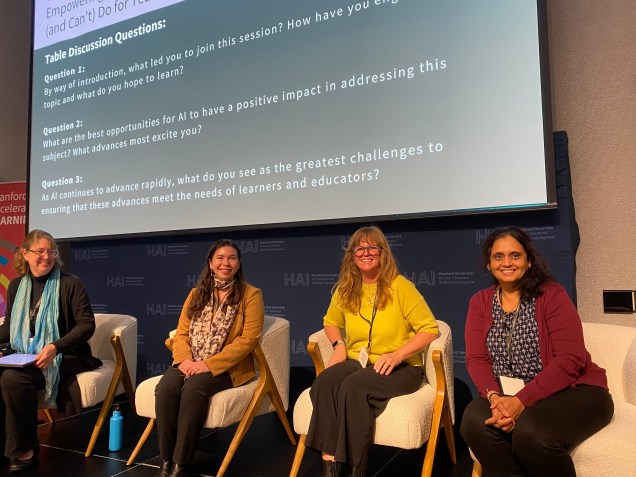
Panel members on the What AI Can And Can't Do for Teachers panel
Photo Credit: Stephanie Sumarna

It’s been a little over a month since I had the opportunity to present on the panel, “What AI Can (and Can’t) Do for Teachers” at the Stanford AI + Education Summit, and I finally have time to reflect on the key takeaways I had from the conference (mostly because I’ve been trying to catch up on grading— clearly, I have not yet outsourced that task to AI).

It felt really exciting and hopeful during an otherwise uncertain and distressing time for this country to hear educators, academics, and non-profit and business leaders discuss their hopes for how AI could create a more positive future for students, while acknowledging the realities that AI literacy is essential and that not everyone will benefit equally from the use of AI in education.

Still, I am skeptical of some of the claims I heard about how AI will transform education for the better, both at the conference and from articles I’ve read online. Based on my experience as a high school English teacher who has taught AI literacy and experimented with AI in my classroom, here is what I think AI can and can’t do for teachers:

  1. AI cannot create more time for teachers to “teach.” One claim I heard repeated both at the conference and online is that AI will free up teachers from busy work and allow us to do more of the heart of what we love to do: teach students. This sounds great at first, but teachers in the US actually spend more time directly in contact with students than teachers in most other countries, leaving little time in the workday for lesson planning and grading. If teachers use AI tools to make the use of their limited unstructured work time more efficient, that would definitely improve our work-life balance, but it wouldn’t necessarily create more time for us to teach students since that’s what we spend most of our contracted work day doing already. I’m concerned that if school districts promote AI as an efficiency tool, they will use the improved productivity from teachers to justify giving us more students per class and even less preparation time during the school day.
  2. AI will not necessarily improve student engagement if we use AI to give students personalized instruction on screens. When I discuss how to make education more engaging with my students, I never hear any of them say that they want a computer program to guide them through tasks that they already don’t enjoy doing. Most frequently they mention wanting to do more hands-on learning, solve real world problems, and play fun educational games with their classmates. AI can help teachers plan more engaging lessons for sure, and it’s already really useful for helping teachers gamify content through apps like Kahoot, Pear Deck, and Quizziz which already have AI features. But I don’t think most students will view one-on-one interaction with a chatbot as a reason to come to school.
  3. AI can’t do the grading for us. AI is useful for assessments for sure, and it can help us automate some of our grading. But as an English teacher, I’m always going to read what students write (not necessarily everything , but some of it). That is how I get to know my students, learn their stories, and understand their strengths and weaknesses. Using an AI tool to summarize how they performed on an essay task without actually reading their work feels dishonest. I don’t mind using AI to supplement the task of giving feedback, however.

That brings me to what I think AI can actually help us do:

  1. AI can help us make learning more accessible. I think there is a lot of potential for AI to help us differentiate our lesson materials and instruction to support students with different skill levels, interests, and needs. It can help us brainstorm new ways to engage students and support them with just-in-time instruction, and it can analyze student data to inform instruction. For example, I’ve used the Brisk chrome extension to analyze trends in my students’ writing based on the rubric I’m using to asess their work.
  2. AI can act as a thought partner for improving our instruction. I think AI will be a really useful metacognitive tool for both students and teachers who will be able to track their progress using AI tools and periodically reflect on their learning. I was excited to see this program developed by researchers at UC Irvine which is experimenting with using AI to help students track their skills and their growth through an ongoing portfolio.
  3. AI can be another voice of feedback for our students. Our students can ask AI chatbots for help when their teachers aren’t available. Students are asking AI to explain complex topics to them in digestible bites, for example. In my English and ELD classes, I use Brisk to provide feedback to my students on their writing before I review it myself so they at least have a baseline for revising their work. Still, if we want to empower students to use AI in a way that supports their learning, we must teach students AI literacy, so they learn how to use AI chatbots as a tool, not as a crutch. We must also teach them to be skeptical of AI’s output. Though hallucinations have decreased, the implicit bias embedded in AI models against marginalized groups still exists, so we need them to think critically about the responses from generative AI and consider how to use these tools ethically.

When considering whether AI will have a positive impact on education, I am a pragmatic optimist. There are so many ways it can be abused, of course, but I do think if we use it thoughtfully it can be a tool for learning that empowers both teachers and students. To do that, we need to use it in ways that are already proven to boost student learning and engagement rather than promote it as a miracle cure for all that ails us in the education system.

Advice for the Overachiever Educators out there

Swag from the Bay Area Writing Project’s Invitational Summer Institute, which I attended last summer.

Recently a student from my alma mater reached out to me to ask me to talk about my experience of being a teacher. I agreed, and realized that somehow I’ve made it to the point in my career where I have advice to give. Right now, I am about five years into my career of being a public school teacher, which is longer than most people make it into this profession. A depressing thought, but an understandable one. I’ve seen a lot of the educators I went to school with or who started out around the same time as me move on to other roles, either in education or in a a completely different field. A year ago, I was ready to leave as well. However, I decided to try out a different school instead, and while my experience hasn’t been perfect by any means, I’ve been able to find a bit healthier of a work-life balance in my new position.

When the student asked me if there was anything I thought people should know about being a teacher, I said that to make it in this profession, you have to be patient. You do not get to see results of your efforts until at least a year or two later after you’ve said goodbye to a group of students, maybe even longer. You also won’t recognize your own growth when you’re in the middle of the stress and pain of dealing with whatever difficulties are in front of you. That doesn’t mean that everyone has to stick it out though. If it feels like the wrong role for you, it’s better to get out than wait and see whether things will improve. Most of the time, things in education don’t spontaneously get better on their own. So you have to decide if you can bear the difficulty of trying to improve your situation or if too much is being demanded of you for too little compensation.

One thing you can try to control as best as you can is the boundaries you set around work and how you approach opportunities that go above and beyond your job description. I, like many other teachers, was an overachiever all of my life– throughout high school, college, and graduate school. That was made possible partially because I was lucky enough to have parents taking care of my basic needs and because I was ignoring my physical or mental well-being so I could be more productive (which led me to having walking pneumonia as a 21-year-old– I do not recommend). However, once I started working as a teacher, I realized that being an overachiever really works to your disadvantage. You will already have more than you can possibly do piled onto you at any given time, so if you adopt the mindset that in order to stand out, you have to go above and beyond your job duties, you will burn out quickly.

I realized this during my first few years of teaching, and while I did experience burnout, especially during remote learning and the hectic in-person years after, I also gradually started to find more balance by cutting myself off from work at a certain time and by prioritizing my physical and mental well-being through exercising, eating well, and meditating. I got to the point where I became mentally OK with leaving work with a massive pile of things yet to be done. Today, I accomplish what absolutely needs to be done for the next day and a little of the stuff that has longer-term deadlines, while having the confidence in myself as a professional to know that the rest will get done at some point. I still work more than my contracted hours and I often work on the weekends because the alternative is working on Friday evenings or Monday early mornings, neither of which sound very appealing to me, but I feel more in control of my workflow.

Still, there was an itch my overachiever self wanted to scratch. While it might have been smart to just accept that one job is enough, and that I needed to stamp out the desire of always wanting to achieve more or advance in some way, I gave into that itch. Since my third year as a teacher, I’ve worked as a freelance writer in addition to my more-than-full-time job, writing study guides, curriculum, and content for apps, and lately, I’ve been leading workshops for other teachers on how to teach writing through the Bay Area Writing Project. Did these second jobs sometimes cause me to lose sleep and add to the stress of my regular job? You bet. But for the most part, I found that when it was a job I was interested in, it fulfilled a yearning for a different type of work than the one I do in the classroom. These jobs keep me motivated to continue developing myself as a writer, and they connect me to that aspect of my identity.

So, what should you do if you’re the overachiever type, and you find it really hard to give that up, even when your teaching job already demands too much? Well, I’ve figured out there is a way to do both. You just have to look for opportunities that overlap. I’ve done that by finding paid fellowships and freelance roles where I get to develop units or lessons that will be published for the broader public that I can also use in my classroom. I am feeding two birds with one plant (to adapt the more violent metaphor).

For example, a couple years ago, I participated in the Teach YR Fellowship through YR Media and developed a project-based learning unit on Social Media and Mental Health that I am still using in my classroom today, and this past year, I became a CRAFT Fellow through Stanford University to develop AI literary resources. I just wrapped up an argumentative writing unit on AI with my 11th grade Honors English students, and I am eager to share what I learned from CRAFT with other educators.

Most of these opportunities came as a result of me joining the community of the Bay Area Writing Project, which is the flagship organization of the National Writing Project. I’ve gained so much more than freelance opportunities from BAWP though. I also found a community of educators who also are passionate about both writing and education. If you are a teacher who is passionate about writing, I definitely recommend getting involved in your local chapter of NWP, and if you’re passionate about a different subject area, there are professional development organizations for all different subjects. It can be an eye-opening and affirming experience to learn from other educators who are experts in your particular field and who work in a completely different setting than you.

While I’ve been exploring these different freelance opportunities, I have to admit my creative writing has taken a backseat. Reflecting on what I want to accomplish in the next year, I reminded myself that working on my own creative writing is just as important to me as receiving recognition or payment for professional writing, so I’m going to focus more on that going forward. Still, I did get a story that I worked on for five years (I wrote at least seven drafts of it) published recently. It’s about two preteen frenemies who bond over feeling like they don’t quite fit into their Chinese summer school. If you’re curious about it, please check it out here.

When to say “No” (and “Yes”) to Opportunities: Finding Time for Creative Writing as a Teacher

Hiking on a recent vacation to Phoenix, Arizona while recovering from burnout

When I was in high school, I thought more was always better. More AP classes, more extracurriculars, more rigor. My overachieving may have helped me secure a spot at an elite college, but ultimately I had to unlearn the impulse to always say yes to opportunities. I might have looked successful on paper, but I remember times during high school where I felt so overwhelmed and anxious about all I had to do that I just kept my head down during class or during after school practice, for debate, Mock Trial, or any other number of activities I was signed up for. I was often short-tempered with people who cared about me, my friends and family, and took out my stress on them. I held it together though, in front of others, so I could keep up that immaculate image of effortless achievement.

In college, I continued the same pattern, double majoring with a minor while running a tutoring program and working a part-time job. One semester, I took on one activity too many and completely neglected one of my obligations, a role as a editor of an undergraduate journal. When it came time to produce the article the writer and I were supposed to be working on, both of us didn’t have anything to show for it. It was really embarassing, and one of the only times I’ve felt like an abject failure. I learned from that experience not to over-commit to too many things at once.

However, when you’re a teacher it’s hard to not over-commit when your job alone takes up more time than you have in a given working day. My first year as a teacher, I didn’t sign up to do any extra duties, but I was getting to work at 7:30 AM and staying until 6 PM on a regular basis. Of course, the first year is always exceptionally difficult because you’re creating most of the materials you’re using from scratch while getting used to having a full workload of students, but I definitely pushed myself too hard. I wasn’t drinking enough water, and at one point, I had to take a day off of work because I had vertigo so bad I couldn’t get out bed.

This year, my third-year of teaching and my first year back in-person since the pandemic started, I was concerned the same thing was going to happen, so I was hesitant to say yes to any extra duties at work. I knew this year would be extra stressful due to the challenges of COVID teaching: wearing masks, helping students who were out sick for weeks, etc. However, I surprisingly found that work was a lot more manageable then I expected, at least at the start of the school year. So I thought it might be doable to say yes to a few more duties: first, being part of the College and Career Readiness Committee at work, second, participating in the Grading For Equity initiative in my district, and third, trying to continue freelance writing in my spare time so I can work on my professional writing skills. I was able to keep up all of the above for months, though I was starting to feel the signs of burnout developing. I was often anxious and irritable, I wasn’t sleeping well, and I felt this constant pressure to always be working. Ultimately, it was the freelance writing and COVID stress that finally tipped me over the edge.

Don’t get me wrong– I really enjoyed the freelance writing that I was doing. I was writing study guides of books for an educational company, and I felt proud of the guides I was writing. However, in order to meet the deadlines, I had to take most of the free time I had after work and use it for freelance writing. This was simply not sustainable and also meant that even when I had put my teaching work aside, I had other work weighing on my mind, preventing me from relaxing. Although I benefitted from the extra income of freelancing, I realized I needed to take a break from it.

The past month, I’ve had time to reflect on what is worth saying “yes” to and what isn’t. I justified the freelance writing to myself for months, telling myself that I was learning valuable skills from it. I wanted to keep up the freelance position for a year so I could put it on my resume, but when the Omicron wave hit and I had to use most of my preparation time at school to sub for my colleagues, I realized it just wasn’t worth it to keep burning myself out with a second job. I had to focus on my full-time job, teaching, to make sure I was doing my best to support my students. Also, since I started doing freelancing, I barely had any time for creative writing. That lack of creative time went unnoticed at first, but then it started eating away at me. Without time to create freely for myself, an overwhelming sense of dullness filled my life. The world felt colorless and my tasks became tedious because I was living to work, not working to live. I was losing my sense of purpose and feeling unsatisfied with the work I was doing.

A month ago, I paused my freelancing, hoping that all the time I was able to put into my freelance position, I would be able to devote to creative writing. However, it wasn’t that easy to transfer time from one activity to another. First of all, I needed to reclaim some of that time for myself, just to exist, without being productive at all, so I haven’t been able to write creatively every evening the same way I was plugging away at my freelance job under a deadline. Second of all, creative writing requires a greater amount of energy and headspace than writing something formulaic, and I can’t always muster that after working a full day of teaching. I’ve started to accept that I will have to find time to write here and there, schedule it into my calendar, and treat it like a second job if I want to make sure it happens, but it doesn’t always have to happen as quickly as possible. Taking a pause and moving through a project slowly also has its benefits.

It’s taking me a while to get back into my creative writing, but the last month of only focusing on my teaching job and my creative pursuits has left me feeling refreshed and energized. I was on break this past week, and it felt so good to actually be able to relax while I wasn’t teaching. I hadn’t felt that relief during Thanksgiving or Winter Break because I had freelancing deadlines hanging over me.

I recently found out that I will be receiving a fellowship for creative writing this summer, the Jack Hazard Fellowship for Creative Writers Teaching High School. I feel really honored by this opportunity because it means I will be able to focus on writing this summer instead of trying to make money from a second job. I also feel excited to have my creative writing taken seriously. I am going to be paid for it, so I will treat it like a job: I will create a schedule for my writing time this summer, create deadlines, and hold myself accountable for writing a certain amount each day.

In the two and half years I’ve been trying to pursue creative writing while working as a public school teacher, I’ve learned that it’s hard to not put professional opportunities first all the time, whether it’s opportunities to be a leader at your school or freelance writing gigs. Since I don’t make as much as a teacher as I would in another profession with my level of education, it’s tempting to always pursue extra income whenever possible. We live in a hustle culture that convinces us that working more and being more productive is always better. But it’s not better if it means you can’t have time to do the things that are important to you. I’m lucky to make enough as a teacher that I don’t actually need a second job; however, not all teachers have that luxury. I’m in a position right now financially that I can say “no” to things and give myself permission to have time for myself and my passions in my free time. I hope I can maintain that balance for years to come, although I know it won’t be easy. Finding balance between teaching and creative pursuits require you to contantly reflect on how you are using your time and find ways to carve out the space you need for yourself.

When I first started out teaching, I heard from veteran teachers that as I got more experience, the demanding hours of teaching would lessen as I was able to re-teach materials I already created or find more efficient ways of working. While I have found this to be true, I don’t think I’ll ever fully find that holy grail of work-life balance because there are always forces constantly tugging on me to do more at my job; meanwhile, I never am completely satisfied with the free time I do have. It never feels like enough. I’ve accepted that I’ll always be caught in this constant vortex, feeling pulled between different obligations. If I have children in the future, that will be another element pulling me in yet another direction. It feels daunting but not impossible to find a way to balance my time between the things that are important to me. I just have to accept that I will have to savor the bites of time for myself here and there that I do have and make the most from them.

My Summer Adventures in Freelance Writing

Image: Raw Pixel Ltd

After my last Zoom call with students ended past June, I checked out more than I have any prior summer while teaching. I was so fatigued from a year and a half of teaching online during a pandemic that I decided that this summer I wasn’t going to think about teaching at all. Of course, that’s not really how it works. If you are teacher, you know that as much as you can promise yourself to not think about teaching, it will inevitably sneak into your life. However, I was able to not think about the logistical aspects of teaching for a while, which was a nice break. Instead of attending a bunch of teacher professional development workshops during the summer, as I have done in past years, I decided to work on developing my own professional skills, specifically my writing skills.

I consider myself a decent writer who can adapt my writing to many different purposes and audiences. I write creatively to satisfy my own desire for storytelling and craft, I blog to share my experiences or to participate in the online literary community, and I journal for myself. The role of teacher, especially English teacher, also involves a fair amount of writing— lesson plans, lesson materials, emails to parents, emails to colleagues, etc. But I didn’t actively pursue much paid professional writing before this summer. If I got paid for a funny satirical article or a short story here or there, I was pleased that someone liked my work enough to pay me for it. However, this summer I realized that I have the skills needed to make some money on the side writing professionally.

First, I took a class on Coursera called The Strategy of Content Marketing, since as a UC Davis alum, it was free. While taking that course, I realized that a lot of what I know about teaching academic writing also applies to professional writing. You’re trying to hook an audience for a specific purpose, to convince them to become your customer or to buy the product of a company you are promoting. Content marketing and copywriting employ a lot of the same techniques as classic rhetoric— convincing an audience to trust you due to your credibility, appealing to the audience’s emotions, and using logic and examples to prove your product or company is valuable (in other words, ethos, pathos, and logos). I realized that whether or not I ended up writing content marketing articles for a client, I could use what I had learned about marketing in the classroom. The high school where I teach recently formed a committee on incorporating college and career readiness skills into the classroom, so in the back of my mind while I was taking the Coursera class, I was thinking of how perfect a writing unit on marketing or advertising would be for demonstrating to my students the value of writing in the “real world.”

After I finished the Coursera class, I decided to try out my new skills by applying to freelance writing roles on Upwork, which is a platform where you can apply for all different types of freelance gigs. I soon realized that despite my previous experiences writing articles for some magazines, it was hard to stand out as a writer on that platform for general writing roles since there is so much competition. However, I noticed that there were some roles that specifically involved writing for education companies or writing educational materials. I started to apply for these positions and had some success. I also applied for some editing roles, too, because as an English teacher and as a graduate student, I’ve had a lot of experience editing other people’s writing.

Once I was able to land a few positions, I discovered that I really like writing professionally. Each gig came with its own rollercoaster of emotions, which gave me some insight into what it must be like for my students when I give them a challenging writing assignment. First, I felt elated whenever I was hired to do a particular task. Then when the client sent me the specific information on what they needed, I would start to second guess myself, feeling imposter syndrome. What if I couldn’t deliver what they wanted me to deliver? It felt scary to face the possibility of failure, even if failure only meant that I wasn’t going to be paid a relatively small amount of dollars.

 I soon discovered that a lot of companies will ask for you to do a “trial” for them if you are writing content for their website so that they can see how you do with a short assignment. Then if they like your work, they will offer you chances to continue writing for them. This way, they can test out if you are a good fit for what they need, and you can also see if you like the type of writing they want you to do. I like this system because at least you get paid a little for trying out the work even if you end up not being hired for a long-term role. This also helped ease my imposter syndrome a lot since I felt less pressure if I knew it was a trial run.

I imagine that my students must also feel overwhelmed at first when they encounter a writing task that they don’t know how to do. I think I can empathize with them more now in this situation because I now know what is feels like to have anxiety when approaching a new writing task. I found that it helped to see models of what the client was looking for, such as a sample article. It also helped to break down the steps of a writing task into more manageable chunks, such as creating an outline and then filling in the outline over the course of a couple days. This sometimes meant that I spent way more time on a task than would be suggested by my hourly rate, since most of the tasks I completed this summer were fixed price projects. However, if I succeeded at doing one task, the next time it was a lot easier to do a similar task. One aspect I had not considered as much about freelancing was negotiating pay, and I am still trying to determine how much money a project needs to pay to be worth my time. Ideally, I would be able to charge a high rate for writing since I have a decent amount of experience as a writer, but in practice it seems like it’s hard to find writing roles that pay well.

Some types of professional writing and editing I tried out this summer included creating reading comprehension questions for short stories, editing transcripts of a professional development podcast and turning them into articles, editing someone’s creative writing and helping them find venues to submit their work, and writing study guide materials. I found myself drawn to jobs that involved creating or editing educational content because I have expertise in that area and because it was fun to take on a different role in education than the one I usually play.

While I don’t see myself making a living solely from writing any time soon (though who knows— maybe I could in the future), trying my hand at professional writing expanded my own understanding of what kind of writing skills are necessary in the workplace. As a writing teacher, it gave me a chance to dip my toes into the “real world” of writing and allowed me to gain experience that I can share with my students. If students ask me why they need to learn a particular writing skill, I now can answer them with confidence, explaining not just why it’s important for future academic courses but also how it could help them earn money in the future. If you teach writing but have not practiced it outside of an academic context, I highly recommend giving freelance writing a spin. It will help you see how academic writing skills can transfer to other contexts, and you will be able to prove to your students the utility of writing.

Writing and Teaching: The Struggle is Real

Today I completed the last requirements of my California Single Subject English Teaching Credential, wrapping up one of the most challenging school years of my life. I managed to survive student teaching, taking a full-time load of classes, passing CalTPA (which is the California Teaching Performance Assessment), and finding a job for the next school year. All that while, I barely had any time to write. I didn’t forget about this blog, and it’s been my goal to write more about the unexpected connections between writing and teaching this whole time, but I simply have not had time. All the responsibilities I’ve had this past year have really drained most of my energy, and while I have written creatively here and there, I haven’t written anything substantial at all in 2019. But I haven’t given up on finding a way to be a teacher and a writer. I’m determined to keep trying, even though I know that it will probably be even more challenging to find time to write in my first year teaching while I’m also earning a second masters degree in education (I’m an overachiever— I can’t help it).

If I’ve learned anything so far about trying to strike a work/life balance, I’ve found the key is to try to leave lesson planning, grading, and teaching things at work. As I take on more responsibilities as a full-time teacher, that will become more difficult, but I still think it’s doable. That frees up mental space for when I come home to relax, clear my head of teaching things, and warm up my writing brain. Easier said than done of course, and most of the time when I get home I just want to read or watch TV, not actively create.

When I’m trying to switch between teaching and writing, sometimes it does feel like I’m using two different operating systems to toggle between them. Although teaching requires constant creativity and adaptation, it’s an incredibly social experience. Writing can be social too, but it primarily requires working alone for long periods of time. Nevertheless, I’ve already started to see how my experience with writing can help support my teaching and vice versa. Over the next few posts, I will explore some of the parallels I’ve noticed between creative writing and teaching

Similarity # 1: Both teaching and writing require radical empathy- but different types.

When you’re writing, you need to be able to get inside the head of any of your characters, even the ones whose thoughts you don’t see directly, even the ones who you find despicable or laughable. You have to be able to see their point of view in order to depict their actions in a believable way. You have to imagine characters’ complex desires and fears and be able to show how characters deceive others and themselves. I believe that the better you know your own characters, the more their humanity will shine through onto the page.

But it’s one thing to do complex psychological manipulations of characters in your head. You don’t have to try to teach them anything, and you can let them run amok as they please. Now put all of your unruly characters into a classroom and try to teach them a lesson. You can no longer write any of your characters off as morally irredeemable or fatally flawed. They are children in your classroom now, so you need to care about every single one and make sure they get what they need from you. When they make careless mistakes, or goof off when they should be paying attention, or say cruel things to you or to the other students, it’s not your job to judge them. When you write, you do so much judging, whether it’s from one character’s perspective judging another, or it’s a snarky narrator. But when you’re a teacher, you have to observe, find out what makes students tick, and figure out how to nudge them in the direction of kindness, curiosity, and determination, whether it’s through praise, rewards, or that dreaded word, consequences.

Characters aren’t so different from students. They come to us with a past, perhaps undisclosed traumas or idiosyncratic habits. I don’t really make characters; I shape the ones that already exist in the world around me and pass through the filter of my brain. Writing lifelike characters is all about exploring potentialities— how would they react in this situation? What are their desires? What are their fears?  Often the decisions I make about characters don’t come from me, or at least not my conscious brain. They arrive as glimpses, smells, colors, feelings. But I still have a decent amount of power over them. After all, I have the ability to breathe them to life on the page, or to toss them in an old drawer in my mind indefinitely, until the point at which I rummage through the drawers and pull them out again, dust them off, and hurl them into a new, unfamiliar setting to see what they do.

I don’t have nearly as much control over my students. And in all honesty, sometimes it can be harder to feel empathy for a real-live human who is frustrating me than it is for a character. But it’s a radical act to see the best in them, even when they seem bent on showing the worst, and to teach them to see the best in themselves.

With my student teaching classes, I think I succeeded at this, always remembering the humanity of my students every day I taught them. I never had more than 30 students at one given time, so it wasn’t that hard to do. I worry that when I have so many more students— five times as many— it will be harder to connect to them on an individual level. It would be like keeping track of 150 different characters in one novel, all at once. But that’s what will be expected of me next year during my first year as a public school teacher. I want to get to know each of my future students, and help them find their own voices. It sounds corny, but as a writer I know there’s no greater gift and no greater challenge than being able to chart your own path through the narrative of life.